In a thermal power plant, steam and water must be controlled to the decimal. A control valve is the final element that turns a control-room signal into real flow, pressure and temperature adjustment.
A poorly sized or worn valve wastes fuel, destabilises the boiler and shortens turbine life.
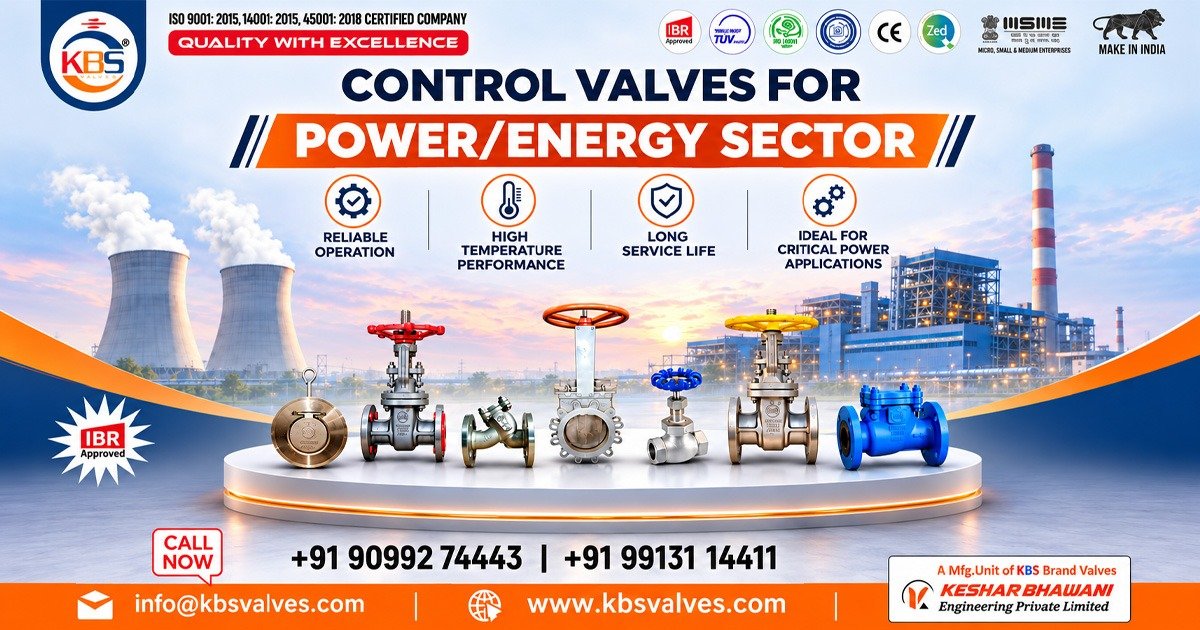
KBS Valves engineers control valves for continuous, severe-duty service across coal, gas, biomass and combined-cycle plants.
What Is a Control Valve in a Thermal Power Plant?
A control valve is a flow-regulating device. An actuator moves the valve trim in response to signals from a controller. It modulates the following:
- Steam flow and pressure
- Feedwater flow to the boiler
- Condensate and extraction flow
- Attemperator spray water
- Turbine bypass flow
Control Valve Applications
- Boiler Feedwater Control Valves: Maintain drum level under variable load.
- Main Steam Pressure Control Valves: Hold stable header pressure.
- Attemperator Spray Control Valves: Control superheater and reheater steam temperature.
- Turbine Bypass Valves: Allow safe startup, shutdown and load rejection.
- Condensate Recirculation Valves: Protect pumps from minimum-flow damage.
- Deaerator Level and Pressure Valves: Ensure oxygen removal stability.
- Auxiliary Steam Control Valves: Supply process and heating steam.
Engineering Challenges KBS Solves
| Challenge | KBS Valves Approach |
| Cavitation in feedwater lines | Anti-cavitation multi-stage trim |
| Flashing and erosion | Hardened, stellited trim |
| Noise from high pressure drop | Low-noise, multi-path cage design |
| Thermal cycling stress | Alloy materials with stable expansion behaviour |
| Seat leakage over time | Precision-lapped seating surfaces |
Why Choose KBS Valves
- Application-led engineering, not catalogue guessing
- Strict material traceability and testing
- Hydrostatic, seat leakage and functional testing before dispatch
- Support for new plants, retrofits and replacement of OEM valves
- Responsive technical and after-sales service
FAQs
1. What is the main function of a control valve in a thermal power plant?
It regulates steam, feedwater or condensate flow, pressure and temperature automatically, keeping the boiler, turbine and auxiliaries stable under changing loads.
2. Which control valve is used for boiler feedwater?
A multi-stage, cage-guided globe control valve is typically used because it handles high pressure drop and resists cavitation.
3. Why do control valves fail in power plants?
Common causes are cavitation, erosion, thermal fatigue, wrong sizing and poor maintenance. Correct trim design and material selection reduce these failures.
4. What materials suit high-temperature steam service?
Alloy steels such as WC6, WC9, F11 and F22 are widely used, with stellited trim for wear resistance.
5. Can KBS Valves supply customised control valves?
Yes. KBS Valves engineers valves to project datasheets, covering size, pressure class, materials, trim and actuation.
6. How often should power plant control valves be serviced?
Inspect during every planned outage, and check trim, packing and actuator calibration sooner if performance drifts.
We Supply Control Valves for Thermal Power Plants in India including locations Andhra Pradesh, Arunachal Pradesh, Assam, Bihar, Chandigarh, Chhattisgarh, Dadra and Nagar Haveli and Daman and Diu, Delhi, Goa, Gujarat, Haryana, Himachal Pradesh, Jammu and Kashmir, Jharkhand, Karnataka, Kerala, Ladakh, Madhya Pradesh, Maharashtra, Manipur, Meghalaya, Nagaland, Odisha, Puducherry, Punjab, Rajasthan, Sikkim, Tamil Nadu, Telangana, Tripura, Uttar Pradesh, Uttarakhand, West Bengal.
Share your plant’s operating data with KBS Valves and receive a precisely engineered control valve solution.
- Website: www.kbsvalves.com
- Email: info@kbsvalves.com
- Phone: +91 90992 74443 | +91 99131 14411
View Product: Click here